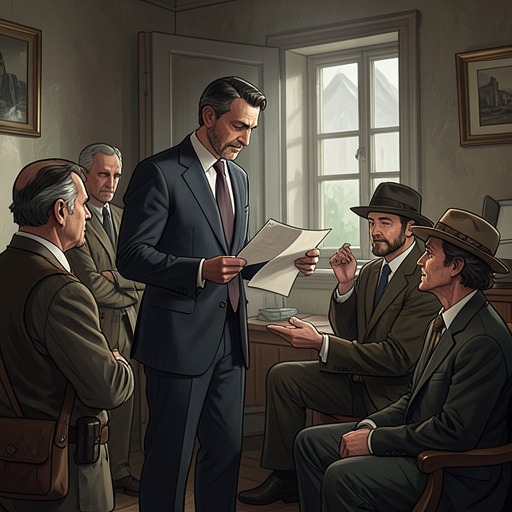
Irvin
Ma Rainey's Black BottomIrvin is the go-between at the recording session: he prepares the equipment, relays Sturdyvant’s demands, and tries to keep Ma Rainey and the record company working together. His job depends on making the session run smoothly, but the play shows the limits of that position. He is held responsible for Ma’s behavior without controlling the studio’s decisions, and his attempts to settle disputes meet Ma’s firm defense of her music and her right to be treated properly.
Position and Working Environment
Irvin first appears in the upstairs recording studio carrying a microphone. He connects it, tests it, crosses to the piano, opens it, and tries a few keys while Sturdyvant watches from the control booth with headphones on. The arrangement establishes their working relationship as well as the room’s divided authority: Irvin handles the equipment and the performers on the studio floor, while Sturdyvant listens and issues instructions from above. A communication horn links the booth to the performers, but it also becomes a source of friction when Irvin objects to having to speak through it.
The studio is only one part of the working space. The band room lies downstairs in the basement, with benches and chairs, a piano, lockers, and forgotten equipment; the recording studio is upstairs, furnished with chairs, a control booth, and access back to the band room. Irvin’s work crosses the boundary between technical preparation and personal mediation. He must make the machinery function, but he is also expected to manage the people whose performances the machinery captures.
Sturdyvant explicitly makes Irvin responsible for keeping Ma in line and warns him against any trouble. Irvin answers that he has things worked out: he has spoken with Ma, says her throat is fine, and says they have gone over the songs. His assurances present him as a fixer who seeks to prevent disruption before recording begins. Yet the responsibility he accepts is broader than his authority. Sturdyvant can issue instructions from the booth and judge what is commercially useful; Irvin must carry those instructions into the room and face the performers’ response.
Mediation, Authority, and Musical Change
Irvin’s position is clearest when the session’s musical direction becomes contested. Sturdyvant wants to hear more from the horn player who has given him songs, arguing that times are changing and that the recordings need a wilder sound and more rhythm. Irvin is therefore not simply supervising a settled plan: he is working within a company that wants new material while trying to keep Ma’s recording on schedule. His role brings commercial preference into direct contact with the performers’ artistic choices.
When Ma hears the band rehearsing Levee Green’s version of her song, Irvin tries to explain its appeal. He praises the arrangement and its horn introduction, saying it gives the number momentum. He also argues that listeners want something they can dance to and that the arrangement can excite them and distract them from their troubles. Ma rejects his case: she does not want to sing the song that way and intends to perform it in the older style, with her nephew Sylvester Brown providing the spoken introduction. The exchange makes Irvin an advocate for a marketable arrangement, but not the final authority over the performance. Ma’s refusal draws a clear boundary around her control of the song.
That boundary is tested again in the studio. Sturdyvant tells Irvin to hurry Ma’s entrance and shorten the introduction. Ma answers the instruction directly, telling Sturdyvant to leave the singing to her and asking where her Coca-Cola is. Irvin responds that they are ready to begin. His readiness does not resolve the underlying disagreement; instead, he tries to move the session forward while Ma insists that the person in the control booth cannot dictate how she sings. The microphone and booth make listening possible, but they do not give Sturdyvant unquestioned authority over the performance.
Managing Disruption and Technical Failure
Irvin also steps in during Ma’s confrontation with a police officer. He asks her to let him handle the matter, identifies her to the officer as one of the recording artists, and asks what the problem is. Ma corrects the form of address, insisting on Madame Rainey rather than accepting a casual designation. Irvin’s intervention is practical: he attempts to establish her professional standing and take charge of the exchange. Ma’s correction shows, however, that she will not let his mediation replace her own demand for respect.
Later, the recording process fails for a reason no negotiation can fix. After Sylvester records the spoken introduction, Sturdyvant reports from the booth that the song has not been recorded properly. Irvin investigates and identifies the cause: the microphone cord has been chewed up and needs replacing. The failure interrupts the session, and Ma declares that the operation is too disorganized and leaves to get her coat, calling Dussie Mae to come with her. Irvin can diagnose the damaged equipment, but he cannot prevent the breakdown from confirming Ma’s complaints about how the session is being handled.
Payment, Paperwork, and Limits
At the end of the session, Irvin brings Ma Sturdyvant’s proposal concerning Sylvester’s pay. He says he tried to talk Sturdyvant out of it, but that the best offer is to take twenty-five dollars from Ma’s money and give it to Sylvester. Ma rejects the arrangement: if she wanted to give her nephew her own money, she would do so; he should receive his own pay like everyone else. The proposal exposes the unequal terms Irvin is asked to carry between the company and the performers. Although he says he argued against it, he is still the messenger of an offer that makes Sylvester’s payment depend on Ma surrendering part of her earnings.
Irvin later tells Ma that he has taken care of everything and straightened it all out. Ma asks him for a pen and signs the forms. The sequence ends with her signature, but it does not erase the earlier conflicts over payment, performance, and respect. Irvin can present terms, attempt to negotiate, and prepare the paperwork; Ma retains the power to challenge his account and decide when to sign. His dramatic function lies in that uneasy middle ground: he is close enough to the performers to manage their immediate needs, yet he remains an intermediary for a business whose decisions he does not control.